
Full Duck Productions
Since 1990, Full Duck has offered a full deck of written and visual communications services, specializing in low-budget video production.
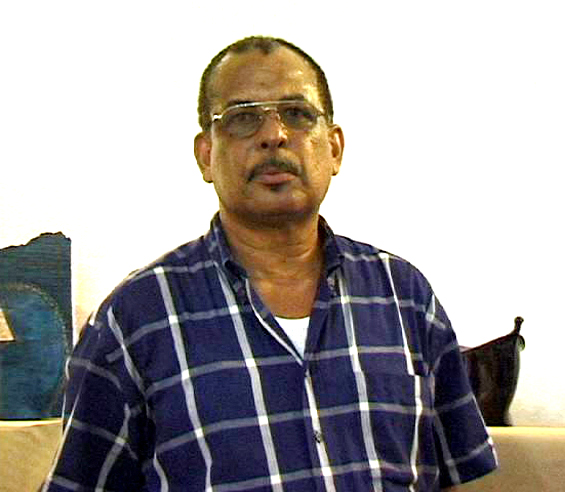
Victor Anicet: Martinican Ceramist, Artist and Historian
Victor Anicet, Martinican Ceramist, Artist and Historian: This internationally recognized ceramist, who studied in France, England and Germany as well as Martinique, gave this interview during a show of his work at the Université Antilles-Guyane in November, 2001. Anicet, a seeker of shadows, a restorer and rejuvenator of the past and a diligent scholar, creates works of art that bring objects and symbols from the culture of his Amerindian ancestors to life for the modern world. In the interview he speaks passionately about this quest, describes his extensive training in ceramics, and shows many of his sculptures and paintings. Among the topics he addresses are the Spanish conquest of the Caribbean islands, the vital heritage left behind by the Amerindians, the horrors of slavery, the multiple races that compose Caribbean society today and the richness of Caribbean culture. A recent inductee of the prestigious Académie Internationale de la Céramique and a celebrated citizen in his native village of Marigot, Anicet describes how his richly textured art includes both real and symbolic elements of African cloth, masks, slave irons, slave ships, East Indian trays, and Amerindian dogs.
Excerpt: I created my works of art after studying certain writings, of Aimé Césaire, Ferrements, and also from my own research. Because the iron collars from slaves you see here in this series of my paintings were harsh and real instruments of torture, and yet they were designed by human beings! That means that the collars had a certain aesthetic form. Since the collars were fitted on to the human body, they could not help but assume shapes that are rather handsome. I emphasized that in my paintings along with the tremendous suffering the slaves endured. These events of the slave trade gave birth to all that happened and from them signs are born. We must give meaning to these different objects that have been used throughout our colonization, throughout our history. We must give meaning to everything that has happened. I always think of the human tragedy that took place under the sea. That’s why the color blue appears so often in my work. You also have the problem of scars, of all the scars that were found under the iron collars, and you find shapes in these scars.
What the Critics Say
As an art teacher, I am always striving to show my students how to think about and make art, which is precisely what Ann Armstrong Scarboro’s films of Victor Anicet and Luc Marlin demonstrate. These films encourage interdisciplinary learning and would offer a perfect supplement to a junior- or senior-level high school art history course or a humanities class that encompasses the arts and history. Erica Green, International Baccalaureate Art Teacher, Niwot High School, Niwot, Colorado
Victor Anicet
Buy Now: Victor Anicet

Read our Purchase Policies about formats, ordering and shipping.
Go to your cart:

 Full Duck Productions